 League of Legends
Rank Boosting (Solo/Duo)
League of Legends
Rank Boosting (Solo/Duo)
MMR Hell vs. Low LP Gains: Why Your Solo Queue Account Gets Stuck and How to Fix It
Stuck getting +17 and losing -25 LP in League of Legends? Learn the real difference between MMR desync and bad luck, how the matchmaking engine calculates your rank, and concrete steps to fix your account.
The Illusion of MMR Hell vs. Actual Rank Desynchronization

In League of Legends, players frequently claim they are trapped in 'MMR hell'—a state where teammates supposedly make winning impossible. In mechanical reality, the game uses two independent numbers to evaluate your standing: your visible rank and your internal Matchmaking Rating (MMR). Visible rank represents your cosmetic progression, while MMR determines the actual skill level of opponents and allies placed into your lobby.
When players notice skewed League Point gains, such as earning +16 LP for a hard-fought win and losing -24 LP on a defeat, they are not cursed by the matchmaking algorithm. Instead, their visible rank has outpaced their internal MMR. The engine uses asymmetric gains as an elastic tether, attempting to pull visible tier placement back down toward the hidden skill bracket where the account currently belongs.
Why Your LP Gains Collapse
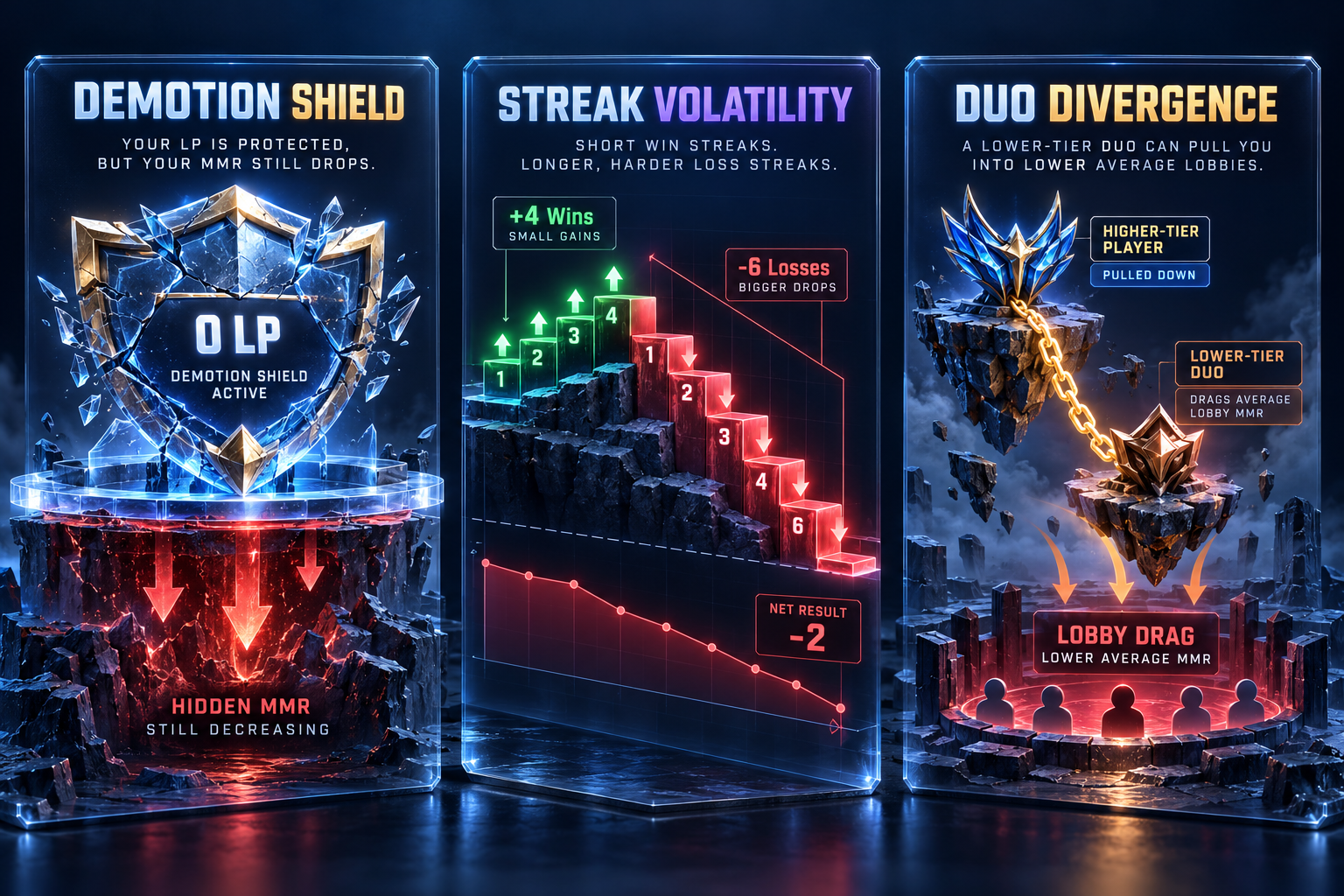
MMR decay does not cause low gains; rather, inconsistent performance patterns do. The matchmaker relies on predictable confidence intervals. When you experience sudden volatility or prolonged plateaus at tier boundaries, the math behind your rating diverges from your visible badge.
Several specific match history patterns trigger this mismatch most aggressively:
- Demotion shield absorption: Losing multiple games while sitting at 0 LP in division IV prevents tier demotion, but hidden MMR continues dropping with every loss.
- Streaky streaks with negative win rates: Winning four games in a row creates visible progress, but dropping six immediately afterward leaves MMR lower than when the cycle began.
- Duo queue divergence: Consistently queuing with a partner whose MMR sits significantly lower than yours drags down average lobby MMR, yielding minimal rating gains per victory.
Diagnostic Checklist: Assessing Account Health

Before changing your climbing strategy, you must evaluate whether your account actually suffers from severe MMR desync or if you are simply experiencing a standard negative variance run. Third-party sites offer rough estimates, but your actual in-client lobbies provide the only verified data.
Look at the lobby composition and match records across your last ten solo games to determine your status:
- Inspect average lobby ranks: If you are Gold II but consistently matched with Gold IV and Silver I players, your internal MMR sits an entire tier below your visual rank.
- Track net LP trajectory: Calculate your net change across five wins and five losses; a negative deficit exceeding 20 LP confirms an active MMR penalty.
- Examine role assignment stability: Being placed into secondary roles or autofill frequently does not affect MMR math, but it often inflates unforced losses that deepen the gap.
Mechanical Fixes to Rebuild Hidden MMR
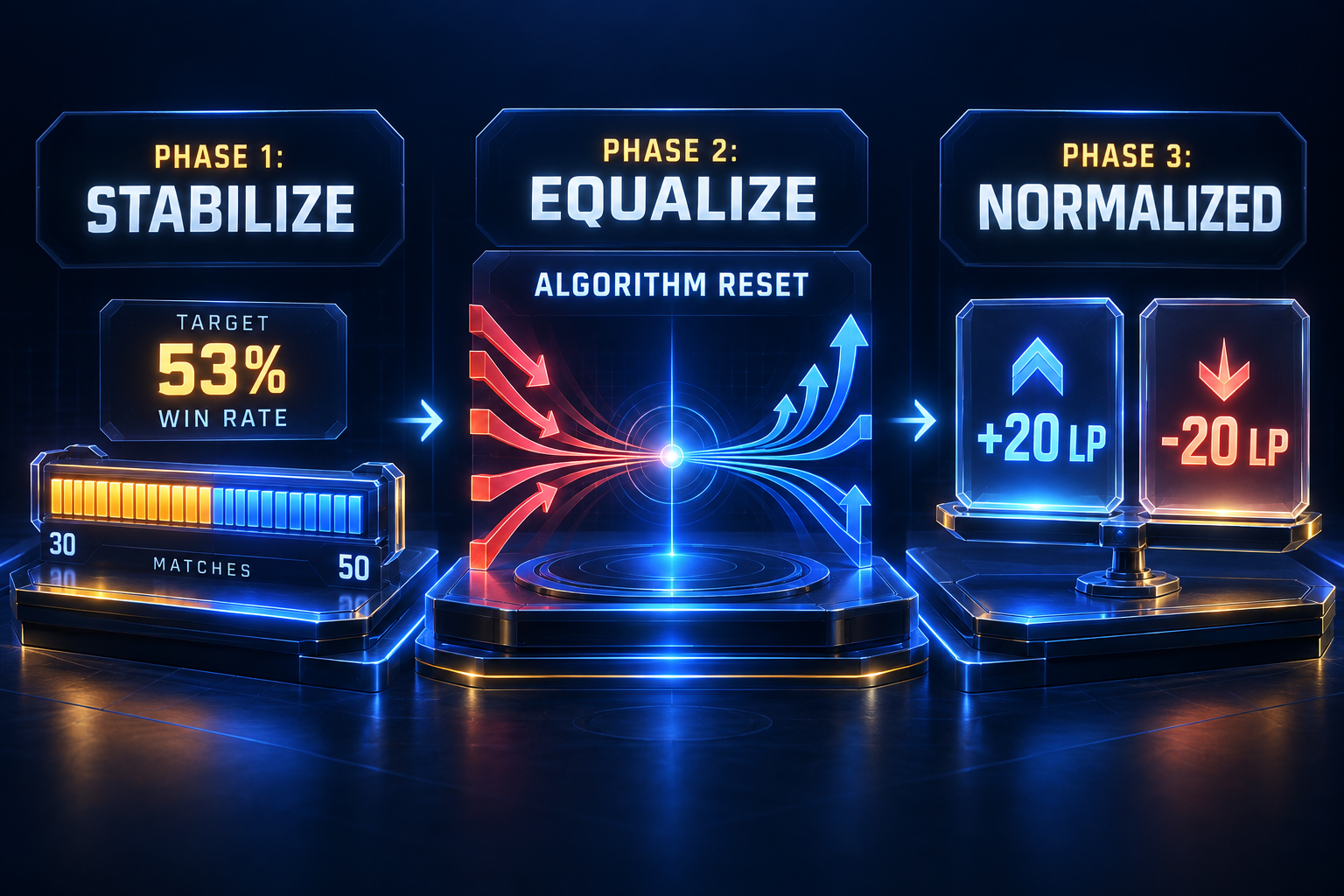
Fixing a damaged MMR ratio requires patience because the system demands proof of sustained baseline performance over volume, not merely isolated winning streaks. Because MMR updates more conservatively than LP, you must stabilize your baseline win rate over a sequence of 30 to 50 matches.
During this stabilization phase, ignore visible tier badges and LP totals entirely. The primary objective is establishing an overall win rate of 53% or higher against your current opponent pool. Once the engine registers that your win rate against that bracket is reliably positive, the negative LP penalty gradually flattens out, eventually normalizing gains to roughly equal numbers on wins and losses.
Choosing Your Path: Self-Correction, Coaching, or Dedicated Assistance
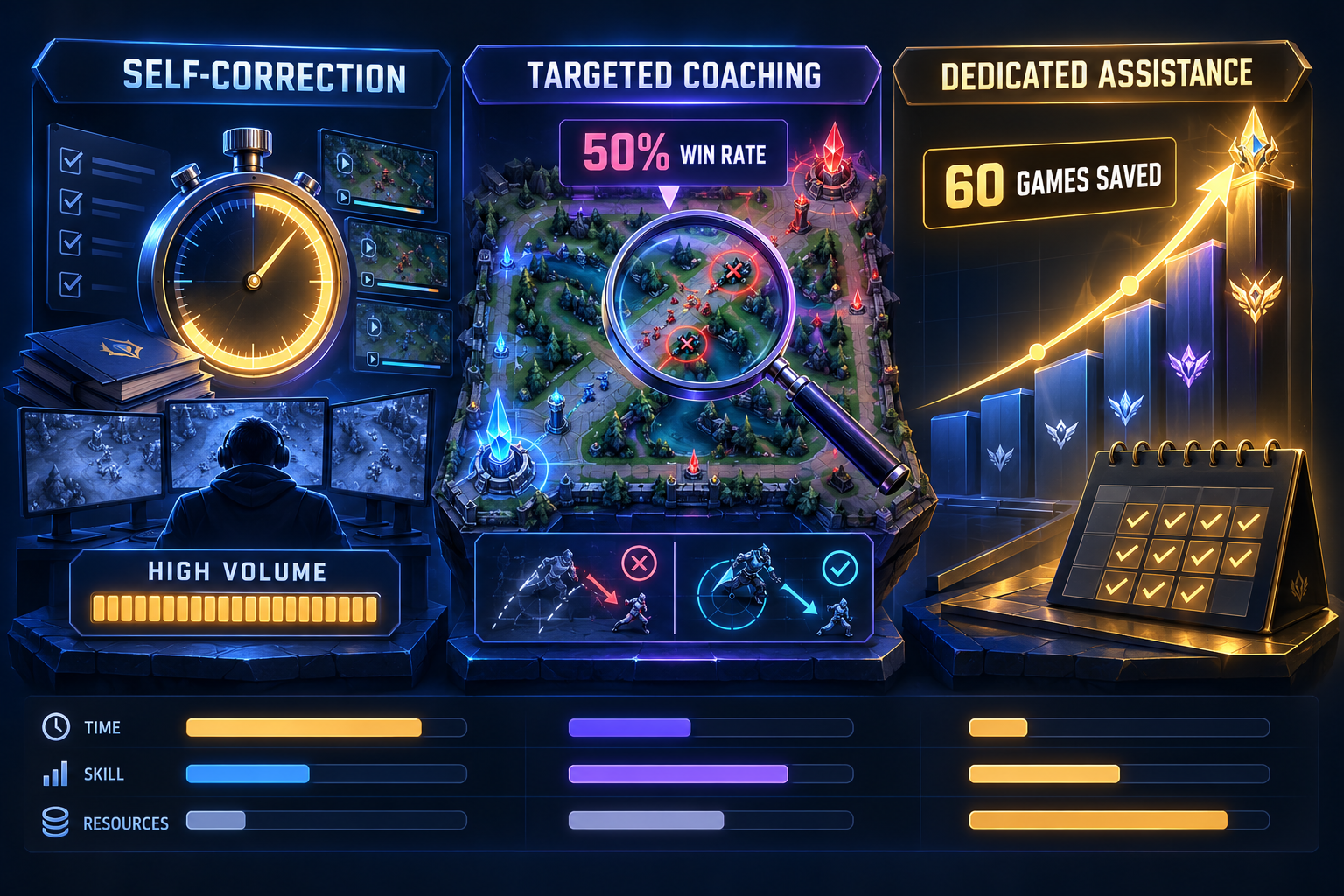
Rebuilding an account with severely degraded MMR requires considerable time investment. Depending on your personal goals and schedule, different approaches offer clear trade-offs between mechanical improvement and time efficiency.
Consider these criteria when deciding how to handle a heavily desynced account:
- Independent rehabilitation: Best if you have ample free time and view grinding through adverse LP ratios as valuable mental endurance training.
- Targeted coaching: Recommended when you are stuck below a 50% win rate and cannot identify which macro mistakes or wave management errors stall your games.
- Account assistance: A practical route if work or life constraints make playing 60 corrective games unrealistic, allowing experienced players to reset MMR stability through efficient high-win-rate runs.
Rank Reset
Overcome Matchmaking Stagnation
Choose between dedicated solo queue progression or tailored duo partnerships to push past stubborn tier bottlenecks and normalize your rating.